1. Home
  2. > CONFERENCES
  3. > 2026
  4. > Strasbourg Summer School in Chemoinformatics – 2026

Strasbourg Summer School in Chemoinformatics – 2026

University of Strasbourg, 22 – 26 June 2026

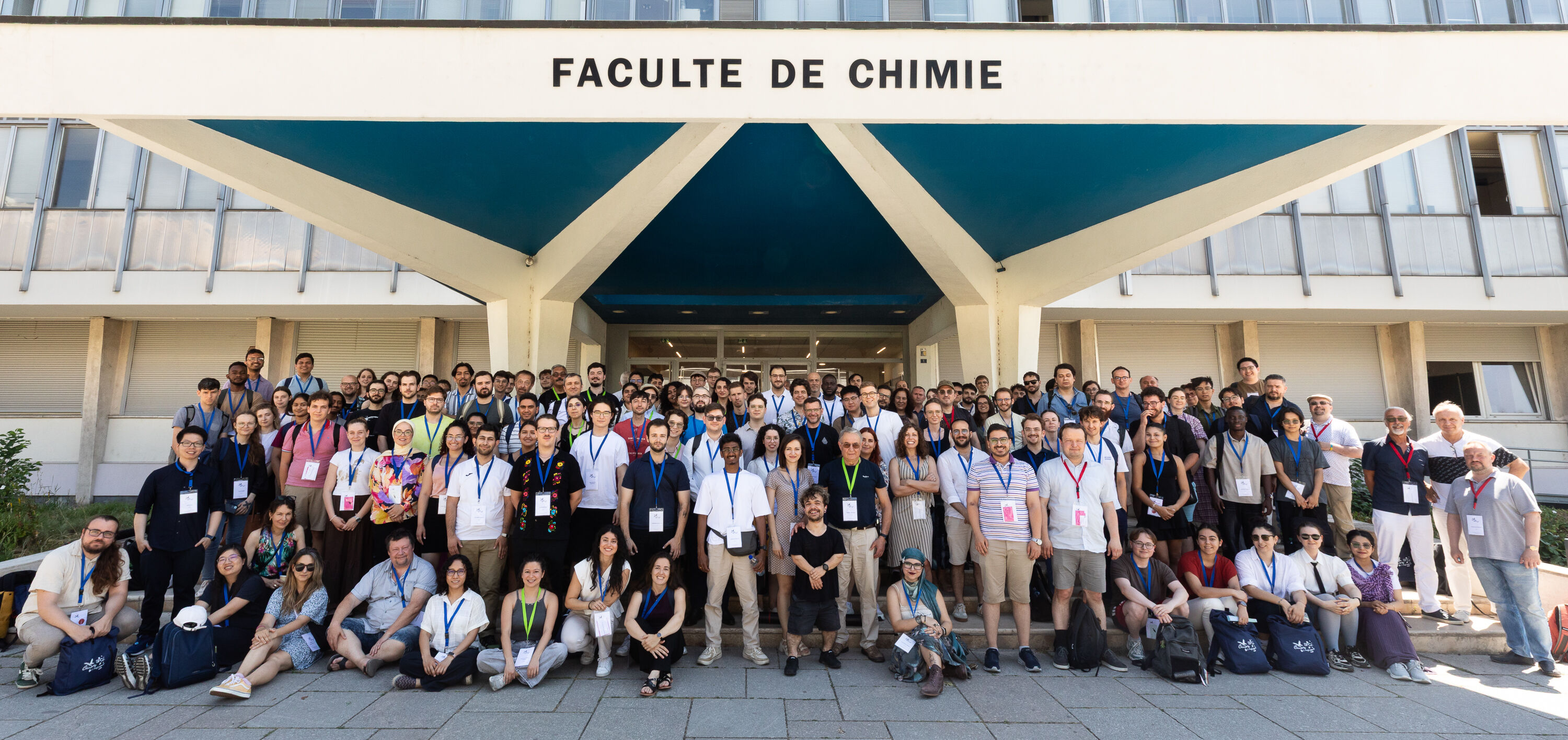
We are happy to announce the 10th Strasbourg Summer School in Chemoinformatics (CS3-2026) to be held in Strasbourg, France from June 22nd to June 26th 2026.

CS3-2026 is a unique school mixing students, young and experienced scientists.

Registration is closed.

The program includes plenary lectures, poster session, oral presentations and hands-on tutorials. It covers the following topics :

  • Artificial Intelligence in chemistry
  • Big Data analysis and visualization
  • Chemical Reactions mining
  • New trends in QSAR modeling
  • Materials informatics
  • In silico pharmacology

Invited speakers :

  • Alexander Tropsha (Univ. North Carolina, Chappel Hill, USA)
  • Artem Cherkasov (Univ. British Columbia, Canada)
  • Mikhail Kabeshov (AstraZeneca, Sweden)
  • Gisbert Schneider (ETH, Zürich, Switzerland)
  • Matthieu Montes (Univ. Paris-Sorbonne, France)
  • Alexandre Varnek (Univ. Strasbourg, France - ICreDD, Japan)
  • Matthias Rarey (Univ. Hamburg, Germany)
  • Thierry Langer (Univ. Vienna, Austria)
  • Olexandr Isayev (Carnegie Mellon Univ., USA)
  • Hanoch Senderowitz (Univ. Bar Ilan, Israel)
  • Esther Heid (Vienna University of Technology, Austria)
  • Claire Minoletti (Sanofi, France)
  • Dmitriy Volochnyuk (Enamine, Ukraine)
  • Andrea Volkamer (Univ. Saarland, Germany)
  • José Medina-Franco (Univ. Mexico)

Registration form and contact


Registration is closed.

You can ask your questions by mail using this email address : chemoinfo-school@unistra.fr

Abstract Submission

Abstracts should be submitted to the Organizers by e-mail before April 15th 2026.
The attachment should be in RTF or DOC format.

e-mail : chemoinfo-school@unistra.fr

The posters should be of the following format : A0, Portrait orientation.

The abstract should be prepared according to a set of rules :
You can download the following word document to use as your abstract template.

Download abstract template

Here is an abstract example :

Communication Title (Arial, 14 pts, bold, centered)
FirstName LastName1, FirstNme LastNme1, FirstNme LastNme 2,… (Arial, 11 pts, centered)

1Laboratory1, University/Institute/Society…, Address, postal code, City, Country.
2Laboratory2, … (Arial, italics, 11 pts, aligned left)

Abstract Text : Arial, simple line spacing, 11 pts, justified

A black&white figure is authorized, referenced in the text as : (figure 1).
Figure legend in Arial, 8 pts, simple line spacing.

Bibliography :
[1] X.X ; Y.Y. J. Catal. 163 (2006) 192-156. (Arial, 10 pts, aligned left)

Please note that the abstract must not go beyond an A4 page (21 x 29,7 cm).
Margins are fixed to 2cm.


Conference fees

Early registration (before April 30th 2026)

Industrial 1000 €
Academics 700 €
Students 500 €
Accompanying person 300 €
Pre-conference session : 300€

After April 30th 2026

Industrial 1100 €
Academics 750 €
Students 550 €
Accompanying person 350 €
Pre-conference session : 350 €

The registration fees covers :

Conference sessions and materials,
Conference dinner on 25 June,
Welcome party on 22 June,
Coffee breaks,
Evening « Beer and Bretzel » parties on 23 and 24 June
Lunches on 23, 24 and 25 June
Cultural program on 25 June


Program


The program includes plenary lectures, poster session, oral presentations and hands-on tutorials. It covers the following topics:

  • Artificial Intelligence in chemistry
  • Big Data in chemistry
  • Chemical Reactions mining
  • New trends in QSAR modeling
  • Material Informatics
  • In silico pharmacology
Chemoinformatics Strasbourg Summer School
(University of Strasbourg, 22 June - 26 June 2026)


All plenary lectures and tutorials will be held in the Faculty of Chemistry building - Amphitheatre Guy OURISSON (1 Rue Blaise Pascal, 67000 Strasbourg) unless specified otherwise.
All coffee breaks, poster sessions and evening events will be held in the Gardens of the CDE - (46 Boulevard de la Victoire, 67000 Strasbourg).
Please note that all participants must present their badge to access any activity !

Monday 22 June

14:00 - 16:40 Registration
CDE (European Doctoral College) (46 Bd de la Victoire, 67000 Strasbourg)
In parallel : Workshops
Amphitheatre CDE
and Amphitheatre Guy Ourisson
16:45 - 17:00 Opening
17:00 - 18:00 Matthias RAREY
University of Hamburg, Germany
New Algorithms for Chemical Space Search and Structure-Based Molecular Design
18:00 - 19:45 Welcome Party

Tuesday 23 June

Chairperson: Artem CHERKASOV

09:00-09:40 Gisbert SCHNEIDER
ETH Zurich, Switzerland
De novo molecular design: From models to molecules
09:40-10:20 Andrea VOLKAMER
University of Saarland, Germany
Data-Driven Exploration of Kinase Inhibitor Space: AI-Assisted, Structure-Based, and Fragment-Guided Discovery
10:20-10:50 coffee break

Chairperson: Alex TROPSHA

10:50-11:30 José L. MEDINA-FRANCO
National Autonomous University of Mexico
Biologically Relevant Chemical Space: From Characterization to Predictive Modeling
11:30-12:10 Mikhail KABESHOV
AstraZeneca, Gothenburg, Sweden
Using advanced chemoinformatics and AI tools for forward synthesis prediction and drug design
12:10-14:00 Lunch

Chairperson: Dmitriy VOLOCHNYUK

14:00-14:20 Arkadii LIN
Insilico Medicine AI Limited, Abu Dhabi, UAE
From Exact Match Dogma to Chemical Plausibility: Rethinking Single-Step Retrosynthesis Benchmarks
14:20-14:40 Yuliana ZABOLOTNA
Eli Lilly, Madrid, Spain
Synthons as common ground: unifying SAR decomposition and building block search for libraries design at Lilly
14:40-15:00 Timur MADZHIDOV
Elsevier Chemistry, Oxford, United Kingdom
From Reactivity Charts to an Industrial-Grade Engine: A Decade-Long Journey to Reaction Condition Recommendation in Reaxys
15:00-17:00 Tutorial 1 – Gilles MARCOU / Nadine BENZIADA
University of Strasbourg, France
Trustworthiness, the Key to Grid-Based Map-Driven Predictive Model Enhancement and Applicability Domain Control
17:00-19:00 Poster session Beer & Bretzel

Wednesday 24 June

Chairperson: Olexandr ISAYEV

09:00-09:40 Thierry LANGER
University of Vienna, Austria
Pharmacophores in Deep Learning Paradigm: Methods and Applications for Advanced Bio-Active Compound Design
09:40-10:20 Alex TROPSHA
University of North Carolina, USA
Rethinking traditional challenges of cheminformatics and QSAR modeling in the age of ultra-large chemical libraries
10:20-10:50 coffee break

Chairperson: Jose MEDINA-FRANCO

10:50-11:30 Hanoch SENDEROWITZ
Bar Ilan University, Israel
X-informatics: A (very) personal view of interesting endpoints to model
11:30-12:10 Esther HEID
Vienna University of Technology, Austria
Deep Learning of Reaction Properties: Role of Reaction Representation and Model Architecture
12:10-14:00 Lunch

Chairperson: Claire MINOLETTI

14:00-14:20 Tagir AKHMETSHIN
University of Strasbourg, France
Bringing retrosynthesis in-house: customized, interpretable planning on your own chemistry with SynPlanner
14:20-14:40 Joao AIRES-DE-SOUSA
NOVA School of Science and Technology, Caparica, Portugal
Chirality Encoding for Machine Learning: NLM Latent Space Arithmetic and Atom-Centered Triple Product Descriptors
14:40-15:00 Andrea MASTROPIETRO
University of Bonn, Germany
Explainable Artificial Intelligence in the Life Sciences
15:00-17:00 Tutorial 2 – Esther KELLENBERGER / Celien JACQUEMARD
University of Strasbourg, France
IChem: An Open-Source Toolkit for Comparing Ligand Binding Modes and Protein Cavities
17:00-19:00 Poster session Wine & Cheese


Thursday 25 June

Chairperson: Hanoch SENDEROWICZ

09:00-09:40 Artem CHERKASOV
University of British Columbia, Canada
Strategies and lessons from CACHE challenges (Critical Assessment of Computational Hit-finding Experiments)
09:40-10:20 Alexandre VARNEK
ICReDD, Japan - University of Strasbourg, France
From Data to Discovery: Why AI Alone Is Not Enough?
10:20-10:50 coffee break

Chairperson: Matthieu MONTES

10:50-11:10 Daniel Rose/ Roxane Axel Jacob
University of Vienna, Austria
NEAT: Neighborhood-Guided, Efficient, Autoregressive Set Transformer for 3D Molecular Generation
11:10-11:30 Serhiy RYABUKHIN
Taras Shevchenko National University of Kyiv, Ukraine
Are the historically available experimental data valid for the AI prediction of the chemical reactivity?
11:30-11:50 Philippe GANTZER
Hokkaido University, Sapporo, Japan
Multicomponent Reaction Optimization for Selectivity in Asymmetric Catalysis
11:50-12:10 Benoît CRETON
IFP Energies nouvelles, Rueil-Malmaison, France
Combined machine learning techniques to predict the thermal conductivity of liquid mixtures
12:10-14:00 Lunch
15:00-19:00 Cultural Program
19:00 Conference Dinner

Friday 26 June

Chairperson: Thierry LANGER

09:00-09:40 Olexandr ISAYEV
Carnegie Mellon University, USA
AIMNet2: Foundation neural network potential for molecules, reactions, and CADD-related tasks
09:40-10:20 Dmitriy VOLOCHNYUK
Enamine Ltd, Taras Shevchenko National University of Kyiv, Ukraine
Chemoinformatic tools for prioritization of the synthetic projects in CRO and chemical suppliers industry
10:20-10:50 coffee break

Chairperson: Gilles MARCOU

10:50-11:30 Claire MINOLETTI
Sanofi, France
Design of an RNA-Targeting Collection: A Methodological Journey Through Chemical Space
11:30-12:10 Matthieu MONTES
CQSB UMR7238 CNRS University of Sorbonne, France
VTX: From High Performance Molecular Visualization to Integrative Modeling of Massive Molecular Systems
12:10 Closure

Location


Strasbourg Summer School - Strasbourg, France, June 22nd to June 26th 2026


Welcome to Strasbourg !

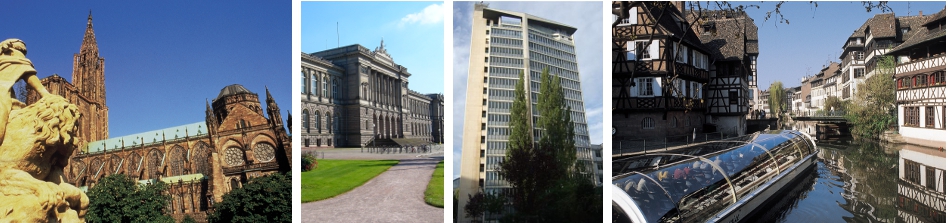
Its magnificent Cathedral, its fine food, "La Petite France" the typical quarter beloved of the tourists, not to mention the Grande-Ile, a UNESCO World Heritage site, have given it its reputation as a city anchored in History and Tradition.

Located in the "Esplanade" district, the Central Campus is near Strasbourg historical center. Also called "Esplanade Campus", it is the main University of Strasbourg Campus, regrouping University headquarters and many University of Strasbourg elements (including the "Tour de Chimie"), as well as the main part of the research units. Several independant high schools are present as well (Ecole Supérieure des Arts Décoratifs de Strasbourg and INSA).


Conference venues

The registration for the conference will take place at the European Doctoral College building in the central campus of the University of Strasbourg (46 Boulevard de la Victoire, 67000 Strasbourg).


The conference will be held at the Amphitheatre Guy Ourisson inside the Faculty of Chemistry building in the central campus of the University of Strasbourg (1 rue Blaise Pascal, 67000 Strasbourg).


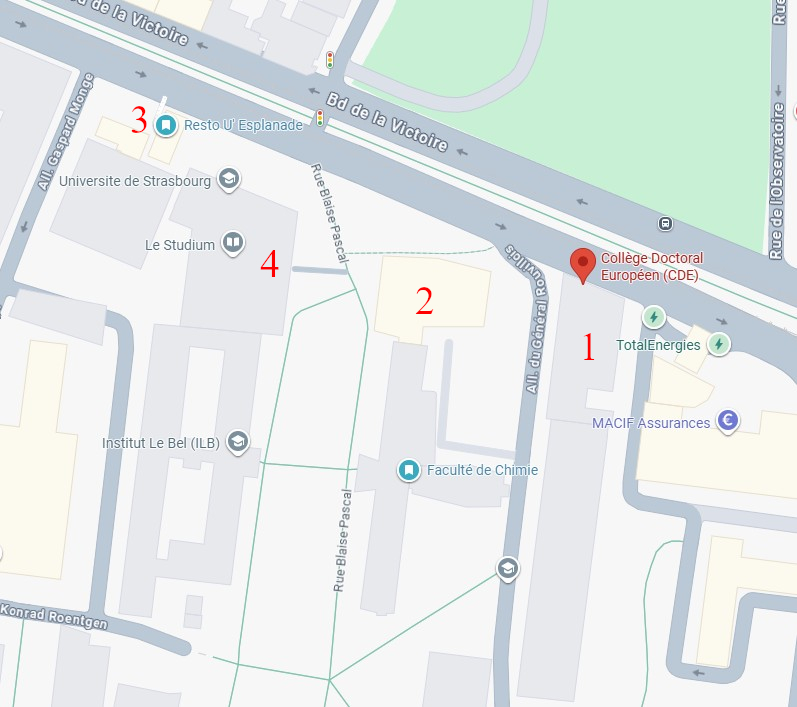
Campus map


1 : CDE (European Doctoral College) (46 Bd de la Victoire, 67000 Strasbourg)
2 : Faculty of Chemistry building - Amphitheatre Guy OURISSON (1 Rue Blaise Pascal, 67000 Strasbourg)
3 : Restaurant "le 32" (Boulevard de la Victoire, Strasbourg)
4 : Studium (2 Rue Blaise Pascal, 67000 Strasbourg)


Some participants will have their lunches at the Paul Appell restaurant. (23 Rue du Jura, 67000 Strasbourg)


How to get to the Conference Venue ?

From the airport

  • Take the shuttle train until the terminus Strasbourg Railway Station (see here)
  • Take the tram line C, direction "Neuhof Rodolphe Reuss" and get off at the stop "Observatoire".

From the train station

Take the tram line C, direction "Neuhof / Rodolphe Reuss" and get off at the stop "Observatoire".

From a bus or tram station

The Central Campus is situated near the tram station "Observatoire" on lines C and E.
Please check the map of the city network Here

You can buy tram tickets via the CTS application (Google Play, App Store), or at each tram station.

By car

Coming from the North, on highway A4:

  • Follow the directions to "Kehl".
  • After the tunnel, stay on the left and follow the direction "Esplanade".
  • Turn left and cross the Pont du Danube.
  • Go straight on Rue d’Ankara and on Rue de Leicester.
  • Turn left to rue de Londres.
  • At traffic light, go straight across avenue du General de Gaulle and the tram rails.
  • Enter the Place d’Athènes, which is in front of the Campus Central.

Coming from the South, on highway A35:

  • Take the Exit "Place de l’Etoile-Neudorf", stay on the left lane.
  • Follow the direction to Kehl.
  • Continue as described above (directions for coming from the North on highway A4).

The map of the central campus is available here.


Photos by Jonathan Martz and Geneviève Engel.


Social events


A short description of the social and cultural events during the school.

Social events

In the evening, all participants are invited to social events, in order to give more time for exchanges, discussions and friendship.

  • Welcome party on Monday, June 22 (CDE - European Doctoral College 46 Bd de la Victoire)
  • Beer & Bretzel on Tuesday, June 23 (CDE - European Doctoral College 46 Bd de la Victoire)
  • Wine & Cheese on Wednesday, June 24 (CDE - European Doctoral College 46 Bd de la Victoire)
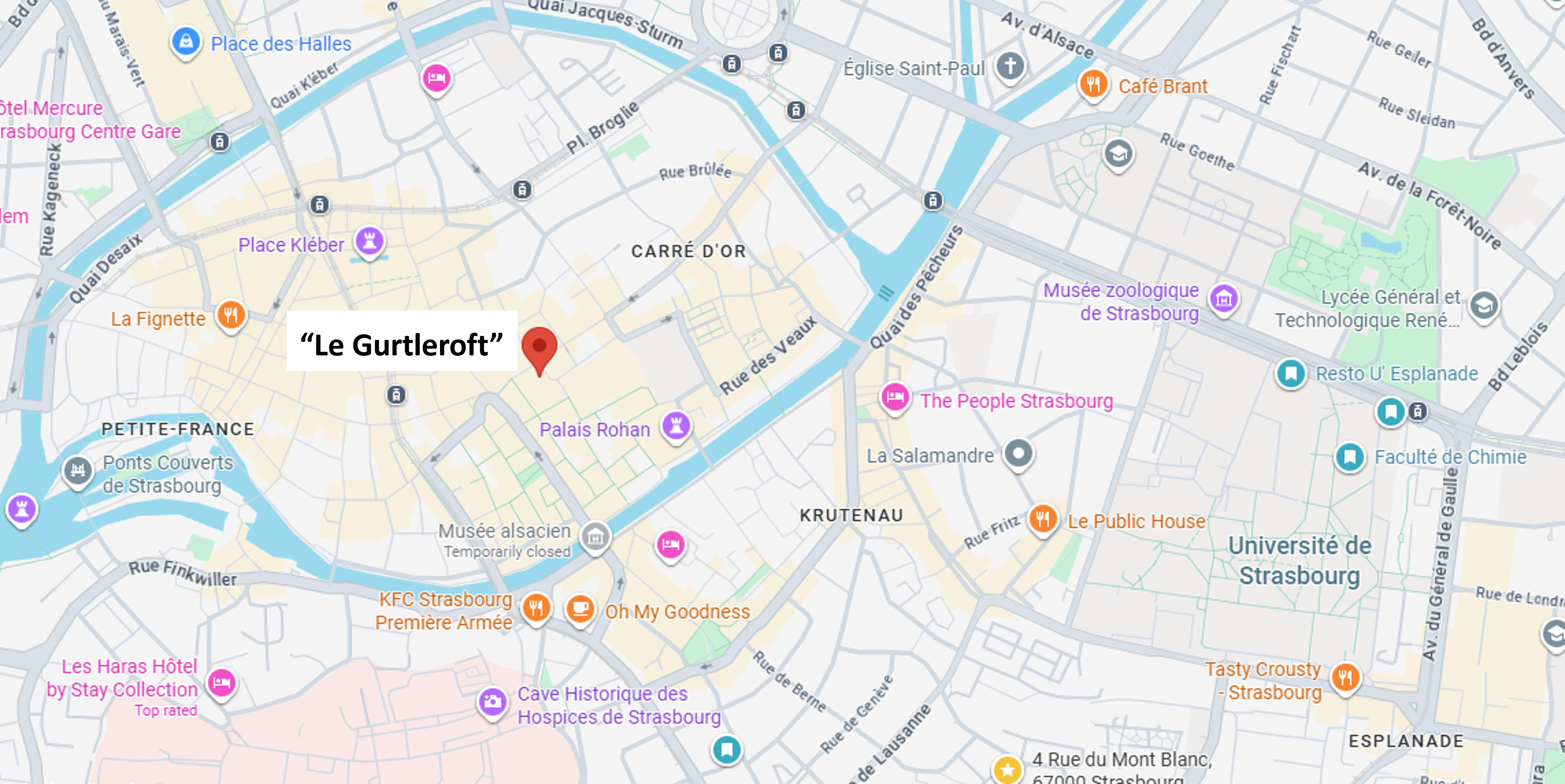
  • Conference dinner on Thursday, June 25 (Restaurant “Le Gurtleroft” 13 Place de la Cathédrale)
Please note that all participants must present their badge to access any activity !

Cultural program

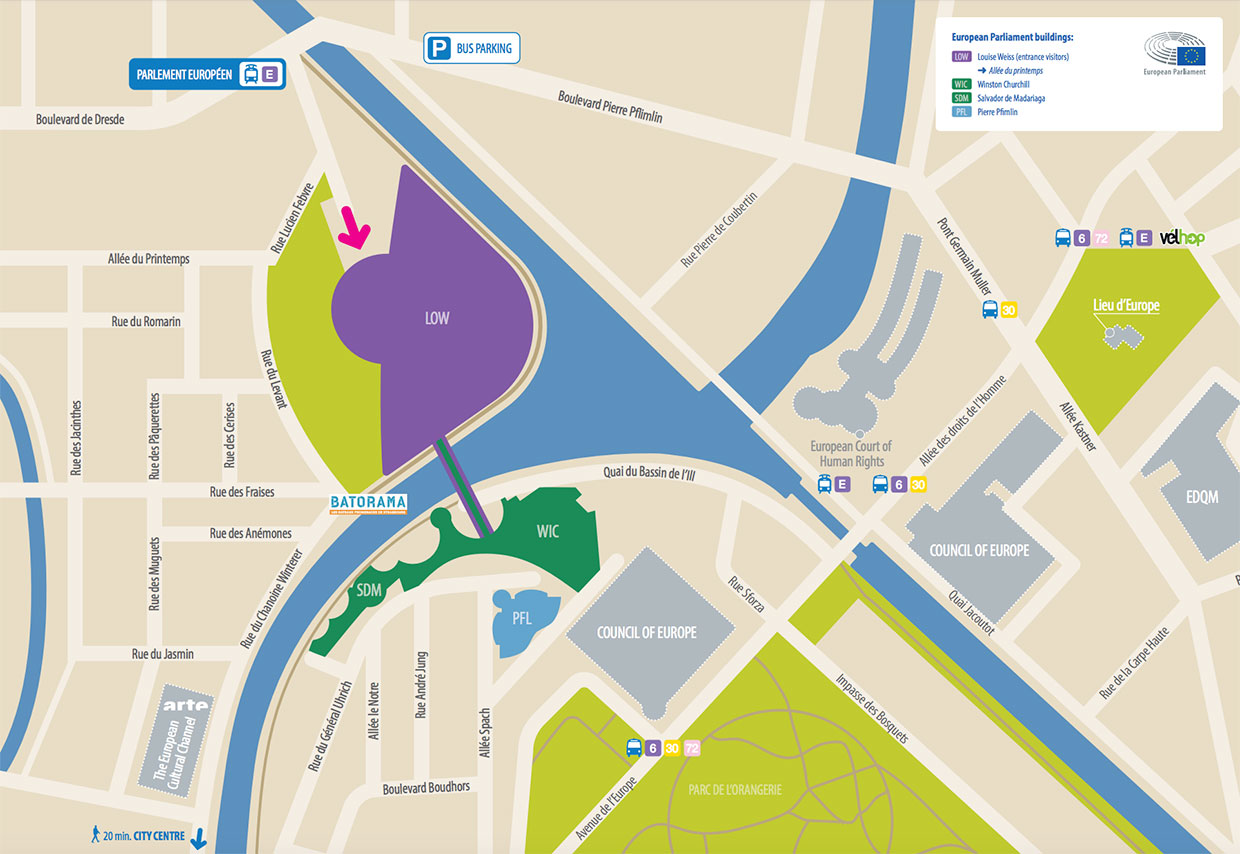
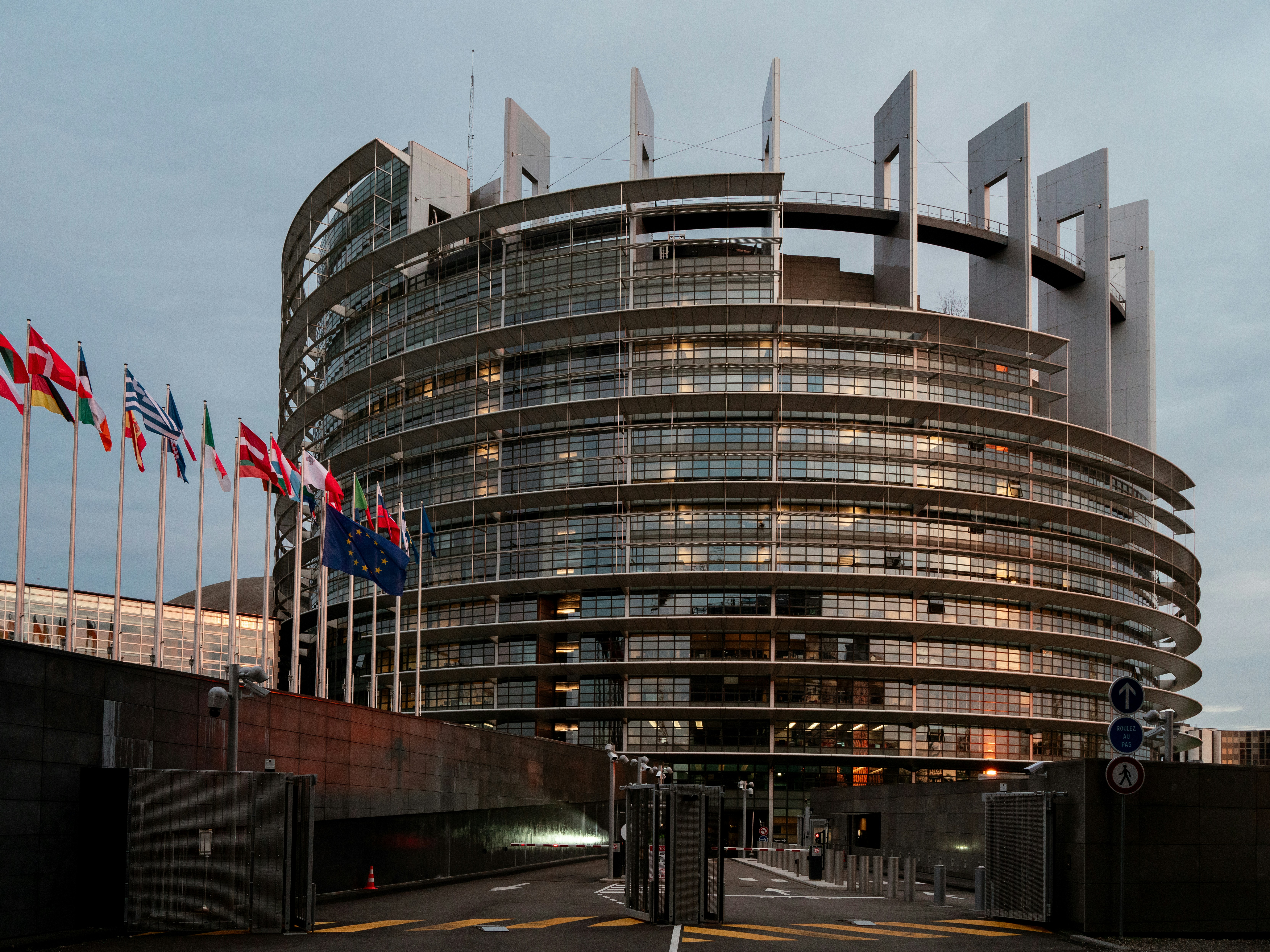
On Thursday, June 25, before the conference dinner, all participants are invited to a guided tour of the European Parliament.

European Parliament
Photo by Lukas S on Unsplash

Please note that a valid passport is required to enter the European Parliament.
Access via Tram E "Robertsau L’Escale" from station "Observatoire" to station "Parlement Européen".

_
14h20 : meet in front of the parliament for English speaking participants
14h50 : meet in front of the parliament for French speaking participants

Gala Dinner


Located at 13 Place de la Cathédrale, within a centuries-old private mansion, this iconic Strasbourg building once housed the seat of the provostry of the Cathedral’s grand chapter during the Middle Ages.
In 1317, this vast building was acquired and transformed by the patrician Conrad Gürteler, and it took on the name Alte Gürtelerhof.
It is precisely to Conrad Gürteler that we owe the construction of the impressive cellars, resembling the nave of a church, which can still be admired today.
For it is here, benefiting from one of the rare geological opportunities offered by the local terrain, that a large cellar was excavated without the risk of flooding. The canons of the provostry stored their wines there during the Middle Ages.
It was only later that Le Gurtlerhoft was converted into a Winstub, where Strasbourgers and Alsatians gather around regional specialties such as tartes flambées, choucroute, röstis, and more. A place for sharing and conviviality.
Crash Course


Crash Course in Chemoinformatics
Monday, 22th of June 2026
2nd floor of Studium of the Strasbourg University (2 rue Blaise Pascal)

9h00 Meet us in front of the Studium (Library) of the University of Strasbourg
(you may recognize us by the Crash Course brochure we carry with us)
09h10-09h55 Dragos Horvath In Silico Drug Design
09h55-10h40 Dragos Horvath Docking – Myth and Reality
10h40-11h00 Coffee break
11h00-11h30 Alexey Orlov Introduction to AI in Chemistry
11h30-12h30 Tutorial (Célien Jacquemard) 3D structure and affinity predictions with Boltz-2
12h30-14h00 Lunch (Restaurant “32” on campus)
14h00-15h00 Gilles Marcou Introduction to data mining
15h00-16h00 Tutorial (Gilles Marcou) From chemical structures to outlier analysis
16h00-16h15 Final Coffee break & Informal Discussions
16h15-16h45 Join Main Conference Registration Desk

Workshops


Pre-conference session : Workshops

Monday, June 22 from 14h00 to 16h00

Amphitheatre Guy Ourisson An Introduction to SMARTS Patterns & Their Applications
Christiane Ehrt & Hadi Vareno,
Computational Molecular Design Group led by Prof. Matthias Rarey
Amphitheatre CDE A wild ride into zillions and back: Generative on-the-fly!
Marcus Gastreich,
Biosolveit.de

Tutorials


All tutorials will be held in the Faculty of Chemistry building - Amphitheatre Guy OURISSON (1 Rue Blaise Pascal, 67000 Strasbourg)

Tuesday 23 June

Tutorial 1 – Gilles MARCOU / Nadine BENZIADA University of Strasbourg, France

Trustworthiness, the Key to Grid-Based Map-Driven Predictive Model Enhancement and Applicability Domain Control

Wednesday 24 June

Tutorial 2 – Esther KELLENBERGER / Celien JACQUEMARD University of Strasbourg, France

IChem: An Open-Source Toolkit for Comparing Ligand Binding Modes and Protein Cavities.


Posters


The poster session will be divided into 2 sessions :

  • First session will feature posters P1 to P29 and will be held on Tuesday, June 23
  • Second session will feature posters P30 to P58 and will be held on Wednesday, June 24

All participants will have to attach their posters during the morning coffee breaks of the corresponding days and remove the posters in the evening of their corresponding day.

Please note that all participants must present their badge to access any activity !


ID Speaker Title
P1 Alessia Casale A Novel Approach to Target a Previously Unexplored Pocket in PI3Kγ
P2 Abraham Brisset Qsaria: Agentic AI for End-to-End QSAR Modeling
P3 Almaz Guilmulin Incorporating In-House Reaction Knowledge into Template-Based Retrosynthesis via Priority Rules
P4 Amaia Elizaran Mendarte Similarity-driven framework for data-efficient polymer property prediction
P5 Angelos Kollias WLOGPnp: adjusting the atomic contribution model for the computational prediction of logP of natural products
P6 Anushka Sen The Challenge of Predicting pKa Values of Organic Compounds. Part I – Data Curation
P7 Aykhan Israfilli Critical Assessment of the Docking Calibration Problem
P8 Christian Jelsch van der Waals Energy Modeling: a Comparative Study of Empirical and Physical Approaches
P9 Côme Ghadi Insights into DltB Inhibition Through Structure-Based Docking and Pharmacophore Screening
P10 Marko Jukić and Črtomir Podlipnik In Silico Mutagenesis of Protein–Protein Interfaces: A DMS-Validated, ThreeTier NOVA/SCWRL Web Pipeline Applied to the SARS-CoV-2 Spike–ACE2 Interface
P11 Dania Cruz-Zamudio Prediction of drug-induced QT prolongation through integration of pharmacovigilance data, structural and physicochemical descriptors
P12 Daniel A. Acuña-Jiménez PUMA v2: An Open-Access Platform for Molecular Diversity Analysis and Chemical Space Exploration
P13 Derin Ozer Toward More Generalizable Reaction Prediction: From USPTO Bias to SMARTS-Based Reasoning
P14 Diana Lorena Prado Romero Bioactivity prediction of coffee seed-derived natural products using a structure-based approach
P15 Elisabetta Grazia Tomarchio Synergizing Pharmacophore Screening and Machine Learning: Identification of Novel Cathepsin L Inhibitors
P16 Nadine Benziada How Soluble Are Metal Complexes?
P17 Abdulwahab Hussein GUI for Chiral Descriptors Calculation
P18 Efthalia Arvanitidou Neuricular: An Online Platform for Integrated CNS Drug Candidate Screening
P19 Mirna Ashri Integrating Morgan Fingerprints and Physicochemical Descriptors for Solubility Prediction
P20 Andre Maio Improving Molecular Docking Accuracy for Binding Affinity Prediction in Virtual Screening: A Critical Review of Methods and Benchmarking Integrity
P21 Damilola Samuel Bodun Pharmacophore-Guided Reinforcement Learning for Novel Covalent BTK Inhibitors
P22 Lukas M. Sigmund BONAFIDE: a Python package for calculating features for atoms and bonds in molecules
P23 Erik Yeghyan Mixture-QSPR for Sustainable Aviation Fuels: Predicting Non-Linear Effects in Oxidation Stability
P24 Fatih Yildirim In Silico Exploration of Aminoglycosides as RNA-Targeting Therapeutics
P25 François Sindt Protein Structure-Based Organic Chemistry-Driven Ligand Design from Ultralarge Chemical Spaces
P26 Galymzhan Moldagulov Hybrid Computational Strategy for Predicting Ligand-to-Metal Coordination Modes in Organometallic Structures
P27 Gomes Antoniel A. S. Identification of Subtype-Selective Binding Sites in the Opioid Receptor Family
P28 Hadi Vareno Deciphering structural artifacts: A machine learning framework to differentiate AlphaFold predictions from crystallographic PDB structures
P29 Halil Ibrahim Erdogan genPI: Generative Polymer Informatics for Structured Polymer Discovery
P30 Henri Berntgen Machine Learning for Predicting Microplastics Hazard
P31 Iryna B. Boiko Predicting Reactivity and Reaction Yields in Parallel Synthesis: Meeting of Expectations and Reality
P32 Jakub Adamczyk MolPILE - large-scale dataset for molecular representation learning
P33 Jessica Trenkwalder Leveraging Heterogeneous Graph Neural Networks for Target Identification
P34 Kamran Heydarov QSPR Models for Predicting Density and Refractive Index of Ionic Liquid Binary Mixtures
P35 Léa Dufay POCK-DB 2026: a standardized protein–ligand binding pocket database integrating ligand-based and geometry-based definitions
P36 Léa Massias Development of an in silico tool for the prediction of new small molecules targeting cytokines
P37 Leonard Bui Design of Beta Sliding Clamp inhibitors using fragment-based method
P38 Louis Plyer Generative Topographic Mapping for Interpretable and Scalable DNA-Encoded Library Comparison
P39 Maksim Vendin MolSpace: Visualization and Analysis of De Novo Generation
P40 Mateusz Praski Benchmarking Pretrained Molecular Embedding Models for Molecular Representation Learning
P41 Mariia Kyrpa A Computational Framework for the Efficient Design of Organic Dyes with Targeted Optical Properties
P42 Miguel M. Leite Solvation Free Energy Prediction Model Across Different Surfaces
P43 Misbah Iqbal Beyond Periodic DFT: Machine Learning of NMR Chemical Shifts in Crystalline Amino Acids with Atomic Environment Descriptors
P44 Mohammad Walid Shahrour Computer-aided drug design of novel Elastase B inhibitors
P45 Nadine Benziada Multi-task QSPR Modelling of the Antioxidant Activity of Organic Compounds
P46 Orkhan Abdullayev AZIMUTH: A Hierarchical GTM-Based Chemical-Space Atlas for Adaptive Zooming, Fast Similarity Search, and Library Comparison
P47 Paola Moyano-Gómez Computational Design of Macrocycles to Modulate TNF-α
P48 Yaelle Fischer Delivering High-Quality Hits through Novalix DEL Platform & Generative AI
P49 Phong Lam MolSanitizer: A Python Pipeline for Preparing Large Databases of Small Molecules for Drug Discovery
P50 Guillaume Schmitz Focus! Don’t Spread: Prioritized Recursive Sub-Search for Retrosynthesis Planning
P51 Souleymane Mahaman Laouali A Foundation Model for Virtual Screening of Ultra-Large Chemical Space Based on 3D Pharmacophores
P52 Sunilkumar Ashok NMR Prediction, Calculation and Molecular Interpretation Complexity
P53 Tryphose Mahoukiego Hounnou Combating A. baumannii: CobB Modeling & Hit Discovery
P54 Uday Abu-Shehab Detecting irregularities in scientific datasets with a domain-agnostic Bayesian framework of numerical distributions
P55 Valentin Guillaume Easy-to-use, offline Molecular Dynamic preparation graphical interface with VTX_2026
P56 Vasilii Factovskiy ---
P57 Wiktor Nisterenko Integrating LSER Descriptors and Machine Learning for IAM Chromatography
P58 Yishuo Chen Digital Driving Exploration of Metal-Organic Supramolecular Architectures

Partners


AiChemist MSCA-DN

Organizers


  • Dragos HORVATH (Chairman) - National Center for Scientific Research (CNRS), France
  • Alexandre VARNEK - University of Strasbourg, France
  • Gilles MARCOU - University of Strasbourg, France
  • Alexey ORLOV - University of Strasbourg, France
  • Olga KLIMCHUK - University of Strasbourg, France
  • Fanny BONACHERA - National Center for Scientific Research (CNRS), France